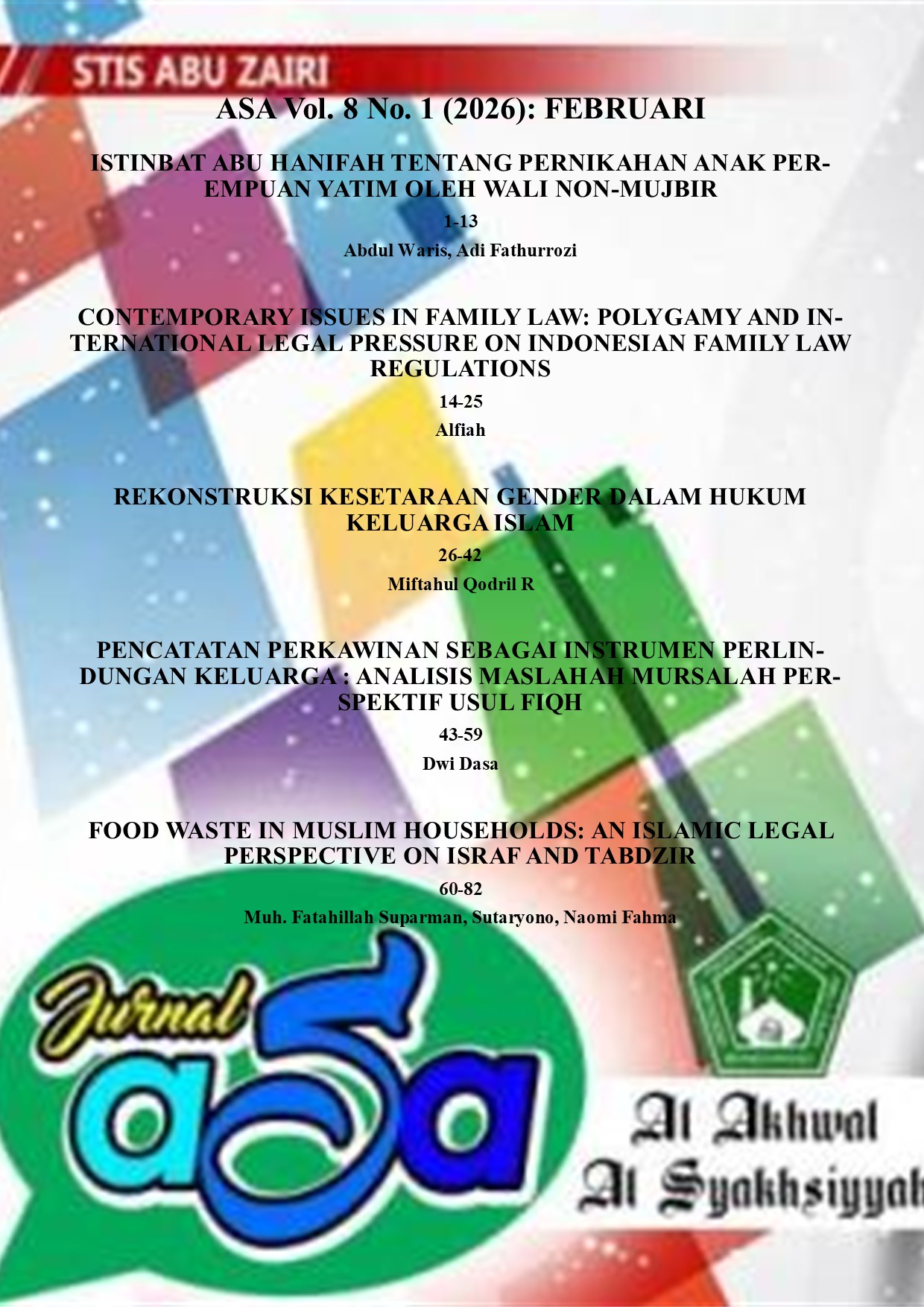
CONTEMPORARY ISSUES IN FAMILY LAW: POLYGAMY AND INTERNATIONAL LEGAL PRESSURE ON INDONESIAN FAMILY LAW REGULATIONS
DOI:
https://doi.org/10.58293/asa.v8i1.210Keywords:
Poligami, Islamic Family Law, genderAbstract
Polygamy is one of the contemporary issues in Indonesian family law that has sparked debate because it relates to Islamic law, national law, and international human rights principles. This study aims to analyze the protection of women’s and children’s rights in Indonesia’s polygamy regulations, examine the influence of international legal pressures and the principle of gender equality on Indonesian family law policy, and explain a model for harmonizing Islamic law and international human rights standards in the regulation of polygamy. This study employs a normative legal methodology using both a statutory and a conceptual approach. Data were obtained through a literature review of relevant legislation, books, and scholarly journals. The results indicate that polygamy regulations in Law No. 1 of 1974 on Marriage and the Compilation of Islamic Law have provided legal protection for women and children through requirements such as court permission, the wife’s consent, financial capacity, and the principle of justice. However, the effectiveness of this protection still faces various obstacles, In the context of harmonization, Indonesia has adopted a moderate approach by continuing to recognize polygamy as part of Islamic law, while imposing legal restrictions to ensure the protection of the rights of women and childrenprimarily due to the practice of “siri” polygamy, which is not legally registered. Furthermore, international legal pressure through CEDAW and the principle of gender equality has influenced Indonesian family law policy by promoting stricter restrictions and oversight of polygamy practices.
Downloads
References
Instruksi Presiden Nomor 1 Tahun 1991 tentang Penyebarluasan Kompilasi Hukum Islam.
Undang-Undang Nomor 7 Tahun 1984 tentang Pengesahan Convention on the Elimination of All Forms of Discrimination Against Women (CEDAW).
Undang-Undang Nomor 16 Tahun 2019 tentang Perubahan atas Undang-Undang Nomor 1 Tahun 1974 tentang Perkawinan.
An-Na'im, Abdullahi Ahmed. Islam and the Secular State: Negotiating the Future of Shari'a.
Cambridge: Harvard University Press, 2008.
Mulia, Siti Musdah. Islam Menggugat Poligami. Jakarta: Gramedia Pustaka Utama, 2007.
Shihab, M. Quraish. Tafsir Al-Mishbah: Pesan, Kesan, dan Keserasian Al-Qur'an. Vol. 2.
Jakarta: Lentera Hati, 2006.
Dama, Fahrun. “Problematika Poligami di Indonesia: Analisis Normatif dan Sosiologis dalam Hukum Keluarga Islam.”: Journal of Islamic Family Law 3, no. 1 (2025): 42–47.
Islamiyah, Nani Nadia. “Perlindungan Anak dalam Keluarga Poligami Menurut Hukum Islam.” ;Jurnal Komunikasi Antar Perguruan Tinggi Agama Islam 22, no. 2 (2023): 239–254.
Jamilah, Jamilah Rizka, Zainul Aziz Nasution, dan Muhammad Saputra. “Analisis Perlindungan Anak dalam Pernikahan Poligami Menurut Hukum Islam dan Hukum Positif.” ALWAQFU: Jurnal Hukum Ekonomi Syariah dan Wakaf 2, no. 4 (2024): 55–66.
Ma’u, Dahlia Haliah. “The Harmonization of Polygamy Between Islamic Law and Legal Law in Indonesia.” Samarah: Jurnal Hukum Keluarga dan Hukum Islam 7, no. 2 (2023): 669–686.
Nasta'in. “Substansi dan Relevansi dari Status Poligami dalam Berbagai PerundangUndangan Hukum Keluarga Islam Kontemporer: Analisis Struktural Fungsional.” ADHKI: Journal of Islamic Family Law 3, no. 2 (2021): 63–78.
Pomalingo, Nazar, dan Edi Gunawan. “Poligami dan Aplikasi Hukum Islam di Indonesia Pasca Putusan Mahkamah Konstitusi Nomor 12/PUU-V/2007 tentang Poligami.” Jurnal Studi Islam 15, no. 1 (2025): 45–62.
Rahmah, Putri Jannatur, Ikke Pradima Sari, dan Muhammad Roy Purwanto. “Praktik Poligami dalam Komunitas Poligami Indonesia Perspektif CEDAW.” At-Thullab: Jurnal Mahasiswa Studi Islam 2, no. 1 (2021): 519–533.
Sa’adah, Isqi Dzurriyyatus, dan Mohamad Sar’an. “Implementasi Praktik Poligami dalam Hukum Keluarga Islam: Analisis terhadap Tafsir An-Nisā’ Ayat 3.” Al-Mawarid: Jurnal Syariah dan Hukum 6, no. 1 (2024): 88–101.
Warsono. “Perlindungan Hukum terhadap Anak dalam Keluarga Poligami Ditinjau dari Hukum Islam dan Hukum Positif.” Nizham: Journal of Islamic Studies 8, no. 2 (2020): 157– 170.
DOKUMEN
Committee on the Elimination of Discrimination against Women (CEDAW Committee). General Recommendation No. 21: Equality in Marriage and Family Relations. New York:
United Nations, 1994.
Committee on the Elimination of Discrimination against Women (CEDAW Committee). Concluding Observations on the Eighth Periodic Report of Indonesia. CEDAW/C/IDN/CO/8. New York: United Nations, 2021.
United Nations Human Rights Committee. General Comment No. 28: Equality of Rights Between Men and Women (Article 3). CCPR/C/21/Rev.1/Add.10. New York: United Nations, 2000.
United Nations. Convention on the Elimination of All Forms of Discrimination Against Women (CEDAW). New York: United Nations, 1979.
Downloads
Published
Issue
Section
License
Copyright (c) 2026 ALFIAH

This work is licensed under a Creative Commons Attribution-NonCommercial 4.0 International License.