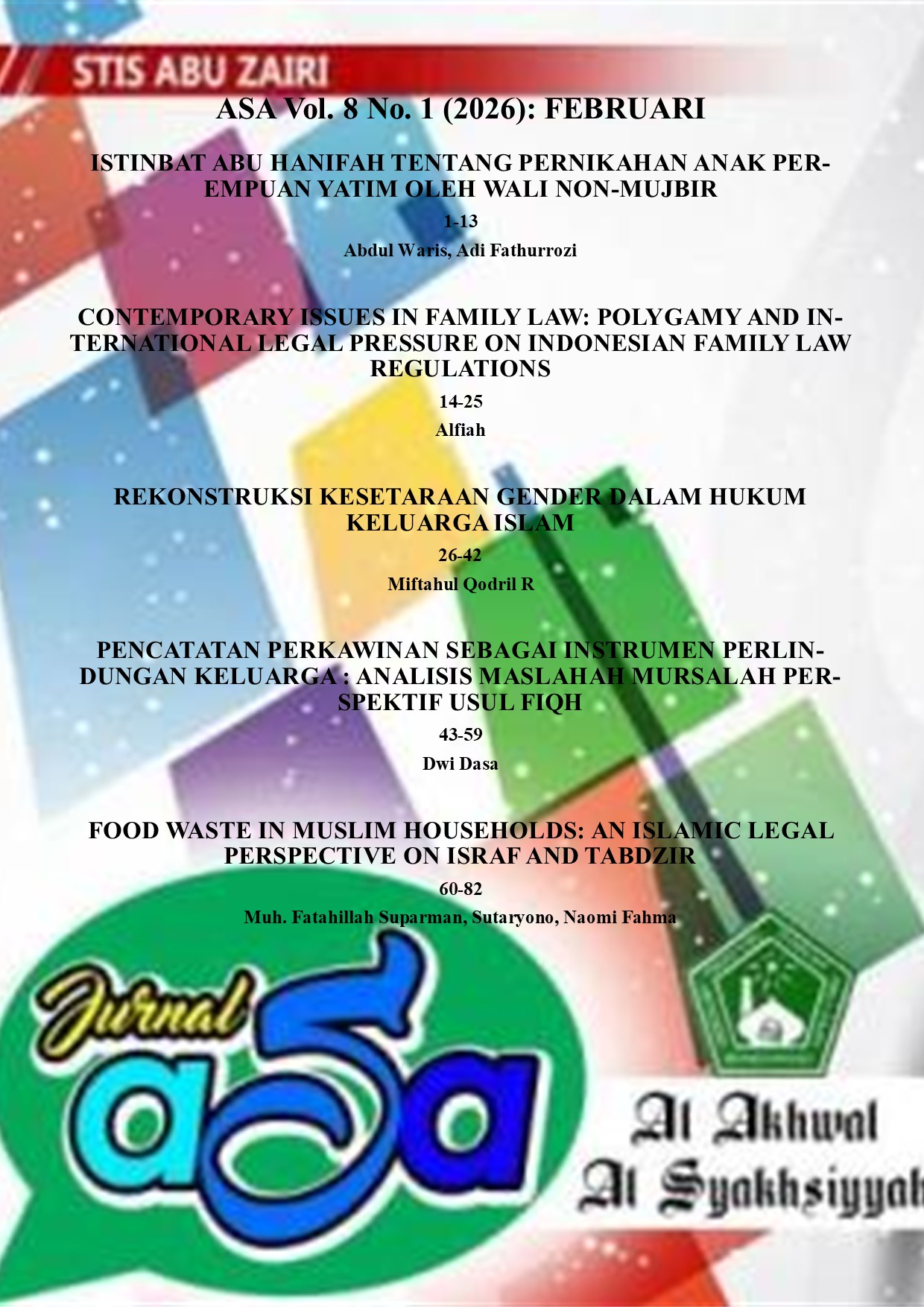
REKONSTRUKSI KESETARAAN GENDER DALAM HUKUM KELUARGA ISLAM: ANALISIS TAFSIR QS. AN-NISĀ’ [4]:1, QS. AL-AḤZĀB [33]:35, QS. AR-RŪM [30]:21, DAN QS. AN-NISĀ’ [4]:34 DALAM PERSPEKTIF MAQĀṢID AL-SYARĪ‘AH KONTEMPORER
DOI:
https://doi.org/10.58293/asa.v8i1.218Keywords:
Kesetaraan Gender, Hukum Keluarga Islam, Maqāṣid Al-Syarī‘Ah, Mubādalah, Tafsir Al-Qur’anAbstract
The issue of gender equality in Islamic family law is a continuously evolving theme within contemporary Islamic legal discourse. Various criticisms directed at Islamic family law often stem from the assumption that certain classical jurisprudence (fiqh) rulings place women in a subordinate position relative to men. Conversely, many contemporary Muslim scholars argue that such inequalities result from patriarchal interpretations of religious texts rather than the core substance of Islamic teachings. This study aims to analyze the concept of gender equality in the Qur'an by examining Surah An-Nisā’ [4]:1, Surah Al-Aḥzāb [33]:35, Surah Ar-Rūm [30]:21, and Surah An-Nisā’ [4]:34, as well as to explore its implications for contemporary Islamic family law reform. Utilizing a qualitative methodology with a library research approach, the analysis is conducted through thematic exegesis (tafsīr maudhū‘ī), contextual hermeneutics, the theory of maqāṣid al-sharī‘ah, and the reciprocal (mubādalah) approach. The findings demonstrate that the Qur'an affirms ontological, spiritual, and social equality between men and women. The concept of qawwāmah in Surah An-Nisā’ [4]:34 does not denote male superiority, but rather represents a moral and social responsibility to safeguard family welfare. This study proposes a reconstruction of Islamic family law that redefines the spousal relationship as an equal partnership grounded in principles of justice, public interest (maṣlaḥah), and human dignity. These findings are expected to contribute to the development of an Islamic family law framework that is more responsive to contemporary social dynamics while upholding foundational Islamic values.
Downloads
References
Abduh, Muhammad, dan Rasyid Ridha. Tafsir al-Manar. Kairo: Dar al-Manar, 1947.
Auda, Jasser. Maqasid al-Shariah as Philosophy of Islamic Law: A Systems Approach. London: IIIT, 2008.
Al-Ghazali, Muhammad. As-Sunnah an-Nabawiyyah baina Ahl al-Fiqh wa Ahl al-Hadith. Kairo: Dar al-Syuruq, 1992.
Al-Maraghi, Ahmad Mustafa. Tafsir al-Maraghi. Beirut: Dar al-Fikr, 1993.
Al-Qaradawi, Yusuf. Min Fiqh al-Mar’ah fi al-Islam. Kairo: Maktabah Wahbah, 1996.
Al-Syatibi, Abu Ishaq. Al-Muwafaqat fi Ushul al-Syari‘ah. Beirut: Dar al-Ma‘rifah, 1997.
Az-Zuhaili, Wahbah. Al-Fiqh al-Islami wa Adillatuh. Damaskus: Dar al-Fikr, 1985.
Barlas, Asma. Believing Women in Islam: Unreading Patriarchal Interpretations of the Qur'an. Austin: University of Texas Press, 2002.
Engineer, Asghar Ali. The Rights of Women in Islam. New Delhi: Sterling Publishers, 2008.
Esposito, John L., dan Natana J. DeLong-Bas. Women in Muslim Family Law. New York: Syracuse University Press, 2001.
Faqihuddin Abdul Kodir. Qira’ah Mubadalah: Tafsir Progresif untuk Keadilan Gender dalam Islam. Yogyakarta: IRCiSoD, 2019.
Fazlur Rahman. Islam and Modernity: Transformation of an Intellectual Tradition. Chicago: University of Chicago Press, 1982.
Fazlur Rahman. Major Themes of the Qur’an. Chicago: University of Chicago Press, 1980.
Ibn Katsir. Tafsir al-Qur’an al-‘Azhim. Kairo: Dar al-Hadith, 1998.
Jalaluddin al-Mahalli dan Jalaluddin al-Suyuthi. Tafsir al-Jalalain. Beirut: Dar al-Fikr.
Kompilasi Hukum Islam. Instruksi Presiden Nomor 1 Tahun 1991.
Mernissi, Fatima. The Veil and the Male Elite: A Feminist Interpretation of Women’s Rights in Islam. Reading: Addison-Wesley, 1991.
Muhammad, Husein. Perempuan, Islam, dan Negara. Yogyakarta: IRCiSoD, 2019.
Nasaruddin Umar. Argumen Kesetaraan Gender Perspektif al-Qur’an. Jakarta: Paramadina, 2001.
Quraish Shihab. Membumikan al-Qur’an. Bandung: Mizan, 1992.
Quraish Shihab. Wawasan al-Qur’an: Tafsir Maudhu‘i atas Pelbagai Persoalan Umat. Bandung: Mizan, 1998.
Saeed, Abdullah. Interpreting the Qur’an: Towards a Contemporary Approach. London: Routledge, 2006.
Undang-Undang Republik Indonesia Nomor 1 Tahun 1974 tentang Perkawinan.
Undang-Undang Republik Indonesia Nomor 16 Tahun 2019 tentang Perubahan atas Undang-Undang Nomor 1 Tahun 1974 tentang Perkawinan.
Wadud, Amina. Qur’an and Woman: Rereading the Sacred Text from a Woman’s Perspective. Oxford: Oxford University Press, 1999.
Ziba Mir-Hosseini. Towards Gender Equality: Muslim Family Laws and the Shari‘ah. London: Musawah, 2009.
Downloads
Published
Issue
Section
License
Copyright (c) 2026 Miftahul Qodril R.

This work is licensed under a Creative Commons Attribution-NonCommercial 4.0 International License.