
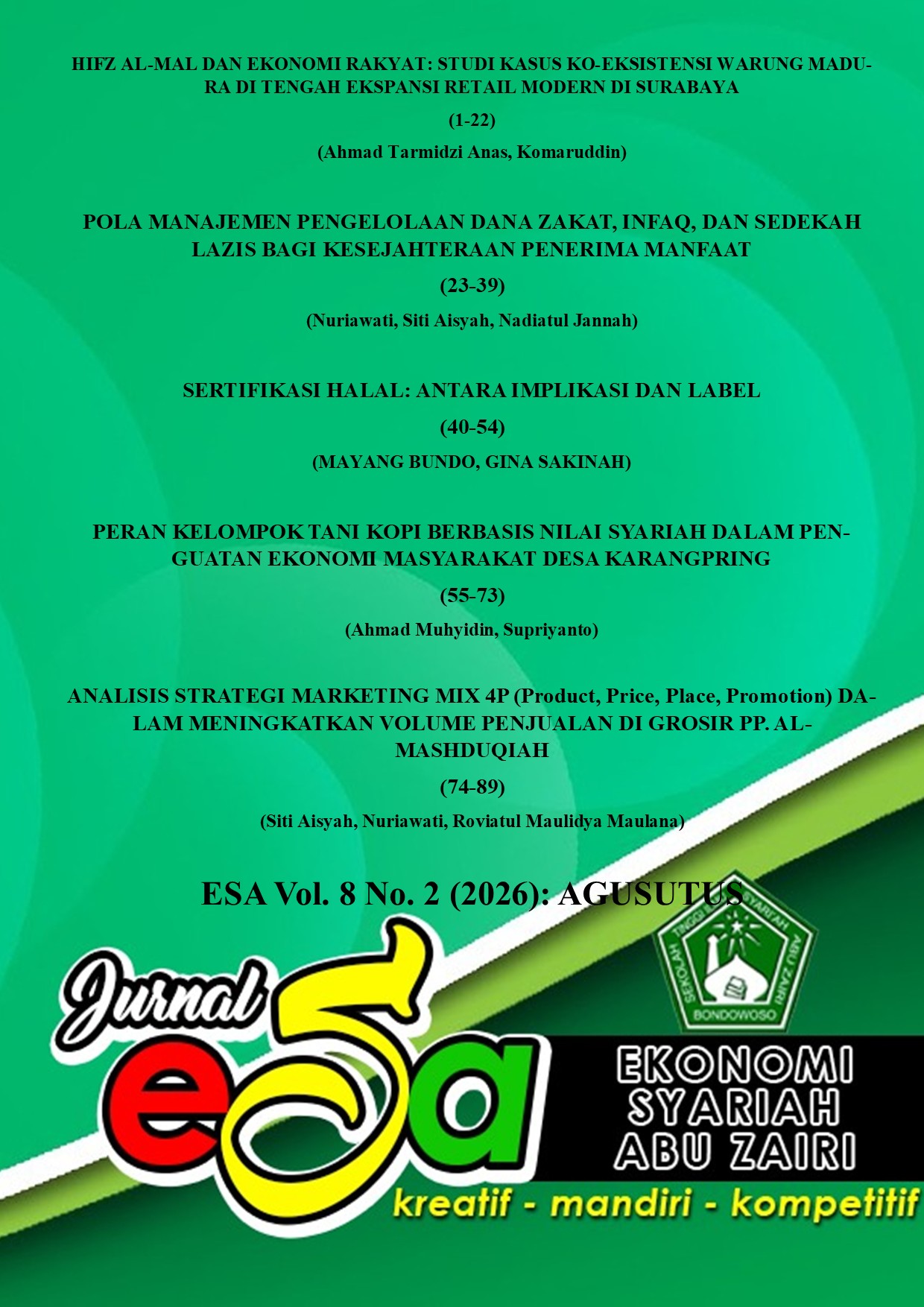
SERTIFIKASI HALAL: ANTARA IMPLIKASI DAN LABEL
DOI:
https://doi.org/10.58293/esa.v8i2.204Keywords:
Halal Certification, Halal LabelAbstract
Halal certification has evolved into an international standard that signifies quality assurance and a lifestyle indicator. The purpose of this study is to analyze the dual role of halal certification in the food industry. This research is driven by the growing consumer awareness of food quality and safety, where halal certification has become a symbol of trust and quality assurance. The method used is a literature review with a qualitative approach, collecting data from various sources such as scientific journals, research reports, books, and official documents. The findings reveal that halal certification plays a significant dual role in the food industry. For Muslim consumers, it provides assurance and confidence that the products they consume comply with Islamic law. For producers, halal certification is a strategic asset that can boost sales and market share, particularly in countries with a predominantly Muslim population. Furthermore, halal certification enhances the company's image and reputation, provides access to the global halal market, and increases competitiveness in international markets. In conclusion, halal certification is not merely a label but has far-reaching impacts for consumers, producers, and the food industry.
References
Ab-Talib, Mohamed, S., Sawar, S. S. M., Hamid, A. B. A., & Thoo, A. C. (2016). Emerging Halal food market: An institutional theory of Halal certificate implementation. Management Research Review, 39(9), 987–997. http://sci-hub.tw/10.1108/mrr-06-2015-0147
Ali, A., Ali, A., Xiaoling, G., Sherwani, M., & Hussain, S. (2018). Expanding the theory of planned behaviour to predict Chinese Muslims halal meat purchase intention. British Food Journal, 120(1), 2–17.
Andani, L., Management, H. Q., Bundo, M., Economics, S., Izzudin, A. F., & Management, S. F. (2024). Impact of Online Reviews on Gen Z ’ s Halal Food Purchase Decisions in Tasikmalaya. 05(02), 317–330.
Ayu Widyaningsih, D. A. W. (2023). Sertifikasi Halal Perspektif Maqashid Syariah. Falah Journal of Sharia Economic Law, 4(1), 61–72. https://doi.org/10.55510/fjhes.v4i1.224
Bonne, K., Vermeir, I., & Verbeke, W. (2009). Impact of religion on halal meat consumption decision making in Belgium. Journal of International Food and Agribusiness Marketing, 21(1), 5–26. https://doi.org/10.1080/08974430802480628
Demirci, M. N., Soon, J. M., & Wallace, C. A. (2016). Positioning food safety in Halal assurance. Food Control, 70, 257–270.
Haryono, H. (2023). Strategi Pengembangan Industri Halal di Indonesia Menjadi Top Player Global. Ad-Deenar: Jurnal Ekonomi Dan Bisnis …, September, 689–708. https://doi.org/10.30868/ad.v7i02.4918
Kohilavani, K., Zzaman, W., Abdullah, W. W. N., & Tajul, A. Y. (2015). Embedding Islamic dietary law into an HACCP approach for application to the poultry slaughtering and processing industry.
Lada, S., Tanakinjal, G. H., & Amin, H. (2009). Predicting intention to choose halal products using theory of reasoned action. International Journal of Islamic and Middle Eastern Finance and Management, 2(1), 66–76.
Muhamed, A. A., Ab Rahman, M. N., Mohd Hamzah, F., Che Mohd Zain, C. R., & Zailani, S. (2019). The impact of consumption value on consumer behaviour: A case study of halal-certified food supplies. British Food Journal, 121(11), 2951–2966. https://doi.org/10.1108/BFJ-10-2018-0692
Mursidah, I., & Fartini, A. (2023). Strategi Mengembangkan Gaya Hidup Halal di Banten: Pengembangan Industri Produk Halal dan Kesadaran Bersyariah. Jurnal Ilmiah Ekonomi Islam, 9(01), 893–904.
Nenengsih, & Muslim, M. (2024). Peningkatan Omzet UMKM Makanan Ringan Pasca Sertifikasi Halal di Sumatera Barat. 95–108.
Othman, K., Sulaiman, M., & Mutalib, M. M. (2018). A PHILOSOPHY OF MAQASID SHARIAH UNDERPINNED MUSLIM FOOD CONSUMPTION AND THE HALALAN TOYYIBAN CONCEPT: Falsafah Maqasid Shariah Membentuk Asas Kepenggunaan Makanan Muslim dan Konsep Halalan Toyyiban. ‘Abqari Journal, 13(1), 75–86.
Perdani, C., Mawarni, R. R., Mahmudah, L., & Gunawan, S. (2022). Prinsip-Prinsip Bahan Tambahan Pangan Yang Memenuhi Syarat Halal: Alternatif Penyedap Rasa Untuk Industri Makanan Halal. Halal Research Journal, 2(2), 96–111. https://doi.org/10.12962/j22759970.v2i2.419
Shafie, S., & Othman, M. N. (2006). Halal certification: an international marketing issues and challenges. Proceeding at the International IFSAM VIIIth World Congress, 28, 30.
Sherwani, M., Ali, A., Ali, A., Hussain, S., & Zadran, H. G. (2018). Determinants of muslim consumers’ Halal meat consumption: applying and extending the theory of planned behavior. Journal of Food Products Marketing, 24(8), 960–981.
Talib, M. S. A. (2015). Motivations and benefits of Halal food safety certification. Journal of Islamic Marketing, 8(4), 605–624.
Vanany, I., Soon, J. M., Maryani, A., & Wibawa, B. M. (2020). Determinants of halal-food consumption in Indonesia. Journal of Islamic Marketing, 11(2), 516–530. https://doi.org/10.1108/JIMA-09-2018-0177
Wahyuni, D., & Arfidhila, N. (2019). Traceability pada rantai pasok pangan halal: Review literatur. Talenta Conference Series: Energy and Engineering (EE), 2(4).
Warto, W., & Samsuri, S. (2020). Sertifikasi Halal dan Implikasinya Bagi Bisnis Produk Halal di Indonesia. Al Maal: Journal of Islamic Economics and Banking, 2(1), 98. https://doi.org/10.31000/almaal.v2i1.2803
Yunus, N. S. N. M., Rashid, W. E. W., Ariffin, N. M., & Rashid, N. M. (2014). Muslim’s purchase intention towards non-Muslim’s Halal packaged food manufacturer. Procedia-Social and Behavioral Sciences, 130, 145–154.
Downloads
Published
Issue
Section
License
Copyright (c) 2026 MAYANG BUNDO, GINA SAKINAH

This work is licensed under a Creative Commons Attribution-NonCommercial 4.0 International License.








 The work is disseminated under