
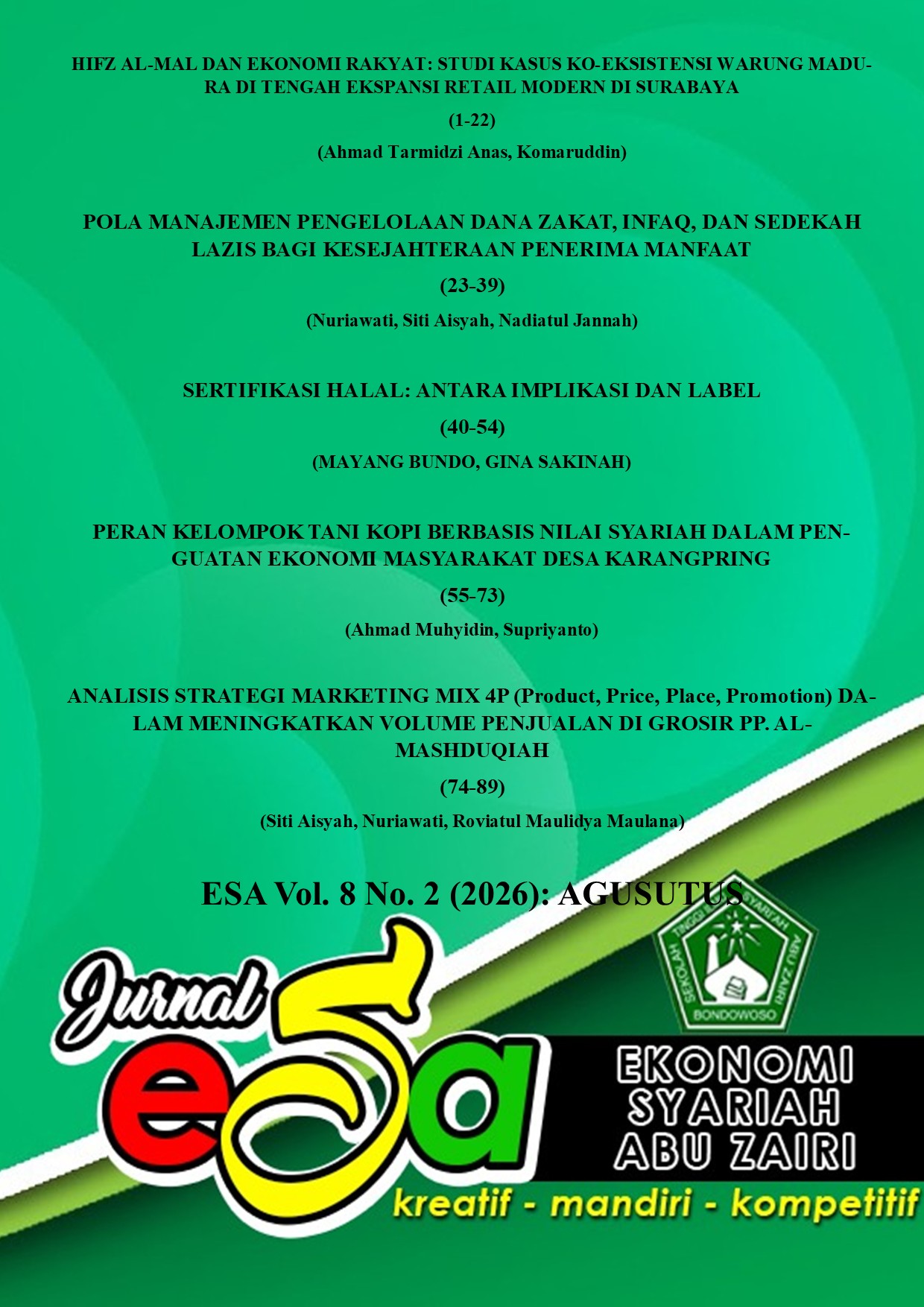
PERAN KELOMPOK TANI KOPI BERBASIS NILAI SYARIAH DALAM PENGUATAN EKONOMI MASYARAKAT DESA KARANGPRING
DOI:
https://doi.org/10.58293/esa.v8i2.211Keywords:
Coffee Farmer Groups, Islamic Values, Economic Empowerment, Ta’awun, MaslahahAbstract
The expansion of modern retail in Indonesia's major cities is often assumed to weaken the existence of traditional retail. However, the Madura warung phenomenon shows the opposite pattern: these ethnicity-based informal retail businesses not only survive, but in many cases benefit from the proximity of the location to modern retail. This multi-site case study qualitative research explores the mechanism of co-existence in five locations with different characteristics in Surabaya, fishing areas (Kenjeran), religious tourism (Ampel), main roads/stations (Jl. Kusuma Bangsa), campus/boarding houses (Gubeng), and market/terminal areas (Wonokromo), with the conceptual framework of sharia maqashid, especially Hifz Al-Mal, combined with the concept of retail cohabitation and ethnic entrepreneurship. Data was collected from 16 informants (five stall owners, five consumers, five modern retail employees or managers, and one Madura community leader) through semi-structured interviews, as well as multi-time field observations. The findings show that co-existence is shaped by product differentiation and operational time, the flexibility of trust-based transactions, the social capital of ethnic networks institutionalized through associations, and the values of Islamic business ethics that are inherited across generations. Cross-location analysis also revealed important variations: the advantages of 24-hour operation hours of warungs are not always significant in locations with modern retail that are also open for a long time (Jl. Kusuma Bangsa), and the character of the area (demographics, surrounding economic activities) has proven to be a much stronger determinant of co-existence patterns than mere spatial proximity. This study contributes to expanding the concept of cohabitation by including the institutional dimensions of social capital, ethnicity, and Islamic business ethics as additional mechanisms that explain people's economic resilience.
References
Abdurrahim, A. (2025). Islamic-Based Farmers’ Group Management in Tobacco Production and Marketing for Members’ Welfare in Senyiur and Pematung Villages. ISLAMIKA, 7(4), 679–715.
Ahmad, S. R., Shadbolt, N., & Reid, J. (2024). Collective action for rice smallholder’s value chain: Insight from Yogyakarta, Indonesia. Journal of Co-Operative Organization and Management, 12(1), 100236.
Christy, N., & Nisa, F. L. (2024). Pentingnya Penerapan Model Pembiayaan Akad Salam dalam Pertanian oleh Lembaga Keuangan Syariah di Indonesia. SHARE: Sharia Economic Review, 1(01).
Das, S., & Singh, R. (2024). Benefits of new generation farmers’ collectives: case reflection from an eastern state of India. Development in Practice, 34(6), 736–756.
Fahlevi, R., Hosen, M. N., & Amalia, E. (2026). Contractual-based Islamic crowdfunding model for sustainable agricultural financing. Jurnal Ekonomi & Keuangan Islam, 22–38.
Fanani, M., & Pohl, F. (2024). FIQH-BASED SOCIAL TRANSFORMATION IN FARMER EMPOWERMENT A Participatory Action Research Approach. Al-Jami’ah, 62 (2), 305–335.
Fanis, S., & Ichfan, H. (2026). Preferensi Pengrajin Batu Bata dalam Memilih Pembiayaan Bank Syariah dan Bank Konvensional: Analisis Faktor Ekonomi, Sosial, dan Religius. Al-Maqashid: Jurnal Ilmu Syari’ah, 1(1), 1–25.
Jacobi, J., Lara, D., Opitz, S., de Castelberg, S., Urioste, S., Irazoque, A., Castro, D., Wildisen, E., Gutierrez, N., & Yeretzian, C. (2024). Making specialty coffee and coffee-cherry value chains work for family farmers’ livelihoods: A participatory action research approach. World Development Perspectives, 33, 100551.
Karatepe, I. D., & Scherrer, C. (2024). Smallholder challenges of social and economic upgrading in agricultural value chains: A cross-country, cross-crop comparison. Agrarian South: Journal of Political Economy, 13(3), 317–340.
Khoirurrosyidin, K., & Tobroni, T. (2026). Islamic Communication in Empowering Muhammadiyah Farmer Communities toward Sustainable Food Security. SAHAFA: Journal of Islamic Communication, 8(02), 73–82.
Ma, W., Marini, M. A., & Rahut, D. B. (2023). Farmers’ organizations and sustainable development: An introduction. Annals of Public and Cooperative Economics, 94(3), 683–700.
Mahboob, M. N. (2025). Exploring Islamic finance as a tool for mitigating agricultural risks. Online Journal of Islamic Management and Finance (OJIMF), 5(2), 111–128.
Mahboob, M. N., Mansor, F., & Madun, A. Bin. (2025). Reviving agricultural finance via Islamic contracts: promoting risk management, economic empowerment, and social justice. Journal of Islamic Thought and Civilization, 15(2), 72–95.
Masruroh, S., Dienillah, I., Supriyanto, S., & Raharto, E. (2025). THE IMPACT OF PRODUCTIVE ZAKAT UTILIZATION ON THE EMPOWERMENT AND WELFARE OF MSMES IN BONDOWOSO. International Conference on Humanity Education and Society (ICHES), 4(1).
Millah, H., & Prasetyandari, C. W. (2025). Peran Kelompok Tani Dalam Meningkatkan Pemberdayaan Petani Kopi Kabupaten Probolinggo. Jurnal Ekonomi Syariah Pelita Bangsa, 10(01), 240–248.
Muharir, M., Hanafi, S. M., & Soehadha, M. (2025). Reciprocity and the values of maqasid sharia among Muslim transmigrant farmers from Java in strengthening agricultural economics. Journal of Islamic Economics Lariba, 11(2).
Napitupulu, R. M., Rusydiana, A. S., & Pratomo, W. A. (2025). Islamic Modes for Agricultural Financing: Which is the Most Suitable? AL-MUZARA’AH-Journal of Islamic Economics & Finance, 13(2), 253.
Noviyanti, R., Pratama, A. F., & Ibrahim, K. H. (2025). Sharia-Compliant Transaction Review of Ijon Agricultural Contracts: Empirical Study from Sobrah Village, East Java. Falah: Jurnal Ekonomi Syariah, 10(2), 54–67.
Pasha, N., Nurbaiti, N., & Syahriza, R. (2026). Assessing the Success of Partnership-Based Food Security Programs through the Maqasid al-Sharia Framework: A Case Study of Farmer Groups in Percut Sei Tuan. Indonesian Journal of Islamic Economics and Finance, 6(1), 427–444.
Santoso, P. B., & Darwanto, D. (2015). Strategy for strengthening farmer groups by institutional strengthening. Jurnal Ekonomi Pembangunan: Kajian Masalah Ekonomi Dan Pembangunan, 16(1), 33–45.
Septiana, N. N., & Khoiriyah, Z. (2024). Metode penelitian studi kasus dalam pendekatan kualitatif. Didaktik: Jurnal Ilmiah PGSD STKIP Subang, 10(04), 233-243.
Wambua, D. M., Ndirangu, S. N., Mogaka, H., & Gichimu, B. M. (2024). Decomposition of the coffee value chain among smallholder farmers in Embu and Kirinyaga counties in Central Kenya. Advances in Agriculture, 2024(1), 9346391.
Yami, A., Solahudin, D., & Herdiana, D. (2023). Pemberdayaan Ekonomi Masyarakat Melalui Kelompok Tani. Tamkin: Jurnal Pengembangan Masyarakat Islam, 6(1), 45–62.
Downloads
Published
Issue
Section
License
Copyright (c) 2026 Ahmad Muhyidin, Supriyanto

This work is licensed under a Creative Commons Attribution-NonCommercial 4.0 International License.










 The work is disseminated under